
Employee engagement is not a one-time initiative or a perk you can toggle on and off. It is a dynamic experience that rises and falls over time. Good managers understand this “engagement curve” and use it to anticipate what their people need, when they need it, and how to respond before engagement dips into disengagement or burnout.
Understanding the Engagement Curve
The engagement curve describes how employee motivation, enthusiasm, and commitment naturally fluctuate over the course of a job, project, or even a day. In most organizations, engagement tends to follow a predictable pattern:
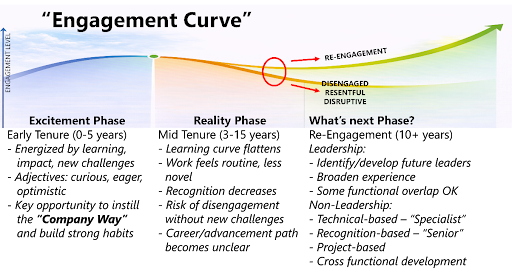
With support, clarity, and wins under their belt, engagement rebounds. People begin to hit their stride and contribute confidently. Over time, even engaged employees plateau if they lack growth or recognition. Left unaddressed, this flatline can become disengagement.
The engagement curve is not a sign of poor performance—it is human behavior. But the manager can understand where each person sits on the curve and actively guide them toward re-engagement.
How Managers Can Keep Employees Engaged and Inspired
1. Create Psychological Safety
Engagement thrives when people feel safe asking questions, sharing ideas, and admitting mistakes—without fear. Being part of a team that is continuously improving not one that is pretending or not listening to improvements.
Managers foster this by:
- Modeling vulnerability (“I do not have the answer yet—let us solve it together.”)
- Welcoming pushback and diverse perspectives
- Rewarding learning, not perfection
Safety is the foundation for sustainable motivation.
2. Provide Clarity—Constantly
Uncertainty drains engagement faster than workload. Every direct report should be able to answer confidently:
- What is expected of me right now?
- Why does my work matter?
- How does success look?
Clarity is not a one-time conversation. It requires steady communication, recalibration, and confirmation of understanding.
3. Connect Work to Purpose
People stay engaged when they see the “why” behind the “what.” Managers can strengthen purpose by:
- Explaining how tasks contribute to company goals
- Narrating the impact customers or other teams experience
- Celebrating meaningful outcomes, not just completed checklists
Purpose gives engagement staying power.
Recognize Effort Early and Often
Recognition does not need to be elaborate—just timely and specific. The best recognition highlights effort, impact, and strengths:
- “Your attention to detail helped us avoid a major issue.”
- “I really appreciate how you simplified that complex problem.”
Recognition reinforces behaviors that lift the entire engagement curve. Creating a culture of recognition could include a “star performers” plan to recognize those who have helped across teams/helped significantly through anonymous nominations, but there must also be a consistent evaluation of those team members or teams who are under recognized in this plan (is it a manager issue, is there an engagement issue, do these people not have the time to help outside of their team or no one is willing to nominate?).
5. Offer Autonomy and Ownership
Micromanagement suffocates engagement. Instead, managers should define outcomes but give freedom on how to reach them. Stating that a person is “in charge” or “the lead,” but holding onto decisions can disengage more strongly than never offering autonomy.
Offer autonomy by:
- Allowing employees to make decisions on their work
- Encouraging experimentation
- Trusting them with meaningful responsibilities
Ownership sparks energy, creativity, and pride. Recognizing these gains should be part of the culture of the company.
6. Provide Real Growth Opportunities
Once employees plateau, engagement stagnates—unless they see a path forward. Growth can include:
- New responsibilities
- Cross-functional exposure
- Stretch projects
- Skill-building workshops
- Mentorship or coaching
Growth should not be reserved for the most tenured—it is the key to retaining rising talent. These opportunities should be listed as goals in yearly evaluations, but also in consistent feedback conversations.
7. Maintain Regular 1:1s with a Future-Focused Lens
Effective 1:1s are not status updates—they are engagement check-ins. Great managers ask:
- “How are you feeling about your workload?”
- “What is energizing you right now?”
- “Where are you feeling stuck?”
- “What is something you want to learn next?”
When employees feel heard and supported, their engagement naturally rises.
8. Watch for Early Dip Signals
Engagement drops are often detectable long before they become performance issues.
Early signals include:
- Reduced curiosity or fewer questions
- Longer response times
- Less proactivity
- Completion of tasks without enthusiasm
- Withdrawing from collaboration
Catching these early allows managers to course-correct with empathy and curiosity, not confrontation.
Synthesizing the Points
The engagement curve is not a problem to solve—it is a natural cycle to understand. When managers stay attuned to where their people are on the curve and respond with clarity, growth, recognition, and humanity, they create teams that not only perform but thrive.
Engagement does not happen by accident. It is built intentionally, conversation by conversation, moment by moment.
Great managers keep their team(s) engaged by finding what works for each individual—this is not a one-size-fits-all approach.
Dustin Demoin is the Director of Radiochemistry at Eckert & Ziegler Isotope Products, Inc. He currently serves as a Member-at-Large for the ACS Division of Professional Relations, Chair of the ACS Division of Nuclear Chemistry & Technology, and Member of the ACS Committee on the Advancement of LGBTQ+ Chemists. Dustin (and his husband) moved to LA for the job after only staying in LA for two nights and has been employed at EZIP for 7 years.

