
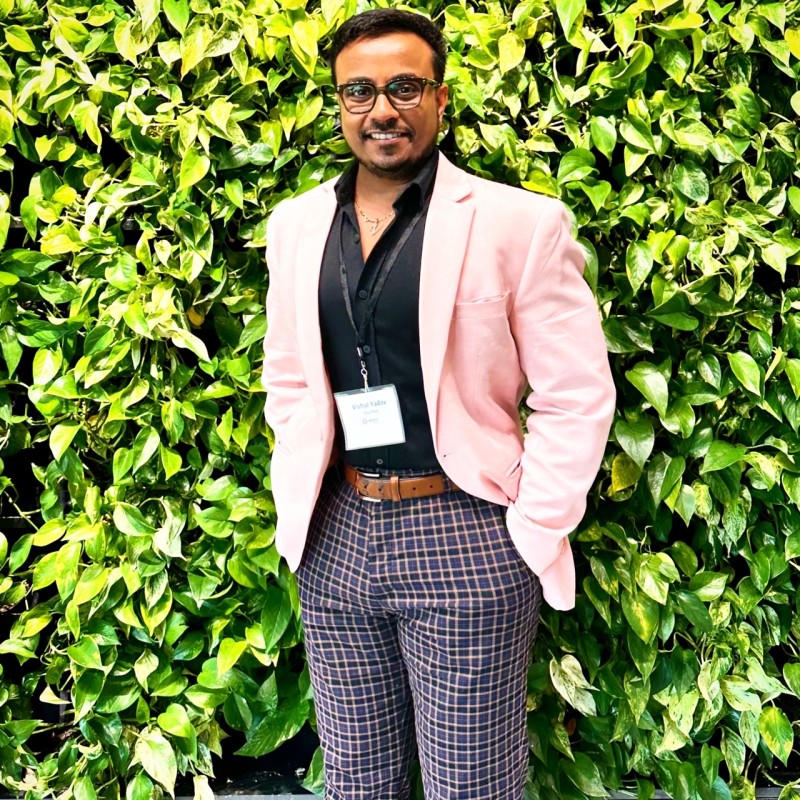
Dr. Vishal Yadav is a Postdoctoral Fellow at Pennsylvania State University, where he studies nonheme iron enzymes and developing mechanistic blueprints for abiotic reactions. He was recently awarded the Division’s Leadership Development Award and elected to serve as the Younger Chemists Subdivision Chair succession. Get to know Dr. Yadav a bit better as he answers questions about leadership, his professional journey, and his involvement with ACS.
Q: What is a trait that you value the most in a leader?
The trait I value most in a leader is empathy. Leaders who truly listen and understand the context behind their team members’ needs create a working relationship built on trust and support. Alongside empathy, I also value direct and open communication. When a leader sets clear expectations and communicates openly with their team members, it helps everyone feel confident in their work and understand how their work supports project goals. So, for me, the combination of empathy and straightforward communication is what makes a leader truly effective.
Q: Name a leader or two that you look up to. Explain why.
Firstly, I deeply admire Dr. A.P.J. Abdul Kalam. Growing up in India, he was a monumental figure who shaped the face of science and technology in our country. He made kids like me believe that pursuing a future in science was truly possible. What I admire about him most is his empathy and resilience despite many political and financial obstacles. He never lost hope and continued to push the country forward, and by doing so, he inspired an entire generation of future leaders in STEM. He showed us the power of leading with compassion and unwavering dedication, and that’s a legacy that continues to inspire me in my own academic career.
My second example is someone I work closely with at Penn State: my postdoctoral advisor, Professor J. Martin Bollinger, Jr. His leadership serves as a tangible, real-world model of how to build and sustain a supportive and dynamic environment for early-career bioinorganic chemists like myself. He combines deep scientific expertise with inclusive, thoughtful mentorship, guiding our team with both strategic vision and genuine empathy. He sets clear expectations, remains highly approachable, and helps us navigate both scientific and personal challenges. Through this approach, he not only advances our research but also supports our growth as individuals and professionals. His mentorship has been profoundly impactful, and he exemplifies the kind of leader I aspire to become.
Q: What achievement are you most proud of?
When I reflect on the achievement I’m most proud of, it’s really the evolution of my journey since coming to the United States in 2016. When I arrived as a PhD student, my goals were straightforward and mainly professional: to succeed in academia, do strong work, and publish my research. That was my primary focus. But over nearly a decade, I’ve come to realize my experience has been about far more than just the lab and the research.
What I’m most proud of is how I’ve grown into a leader and discovered my ability to positively impact the journeys of others. Alongside the scientific accomplishments I deeply value, I’ve discovered profound fulfillment in community-building, mentorship, and contributing to something larger than myself.
This growth has unfolded through a series of moments that revealed an unexpected truth: I didn’t come to the United States solely for professional advancement. I’ve developed in numerous ways, as a mentor, a colleague, a leader, and a human being. It has been both surprising and deeply rewarding to recognize that I can support others and help create positive change in their lives.
Being recognized with honors such as the ACS Professional Leadership Award and the Merck Next Generation Leaders Award holds a special meaning for me. These acknowledgments reflect not only my scientific work, but also my commitment to fostering inclusive, supportive spaces and investing in the transformational power of mentorship. They serve as an enduring reminder that the impact we have on others can be just as significant as any paper we publish, and that is what I’m most proud of.
What are you looking forward to in your professional journey?
In my professional journey, I am most excited about stepping into an independent faculty role where I can shape and lead my own lab environment. I look forward to training the next generation of scientists in chemistry and biochemistry, fostering a space where innovative research, collaboration, and mentorship can thrive. Creating an environment that supports both scientific excellence and personal growth is something I am deeply passionate about as I take the next steps in my career.
How would you like to engage with ACS more in the next year?
In the coming year, I am especially excited to deepen my engagement with ACS and build on the initiatives I’ve already begun. For example, I organized an ACS symposium for early-career scientists at the Fall 2025 conference in Washington, D.C., and I look forward to continuing to create spaces like this where emerging scholars can share their work, connect, and grow. My goal is to bring together early-career professors, students, postdocs, and trainees to foster meaningful dialogue and professional networking.
I am also eager to step into my role as Chair of the ACS PROF Younger Chemists Committee for 2026–2027. In this position, I plan to focus on strengthening professional development opportunities and expanding networking pathways for early-career scientists. Overall, I look forward to participating in and leading panels, workshops, and outreach initiatives that strengthen the bonds of our community and support the next generation of chemists.
You can connect with Dr. Vishal Yadav on LinkedIn.
Want to get involved with the PROF Younger Chemists subdivision? Email younger@acsprof.org to get connected!

